San Antonio Rain Garden
San Antonio, TX · ecological drainage
Rain Garden & Side-Yard Drainage Regrade
A chronically wet side yard was regraded and reshaped to move stormwater away from the house and toward a native-planted rain garden, avoiding a conventional French-drain approach that would have risked disturbing mature tree roots.
Real project photos
Before, grading work and the finished rain garden.
These are Dom's original San Antonio project photos, showing the wet side yard, reshaped drainage path and completed native-planted system.
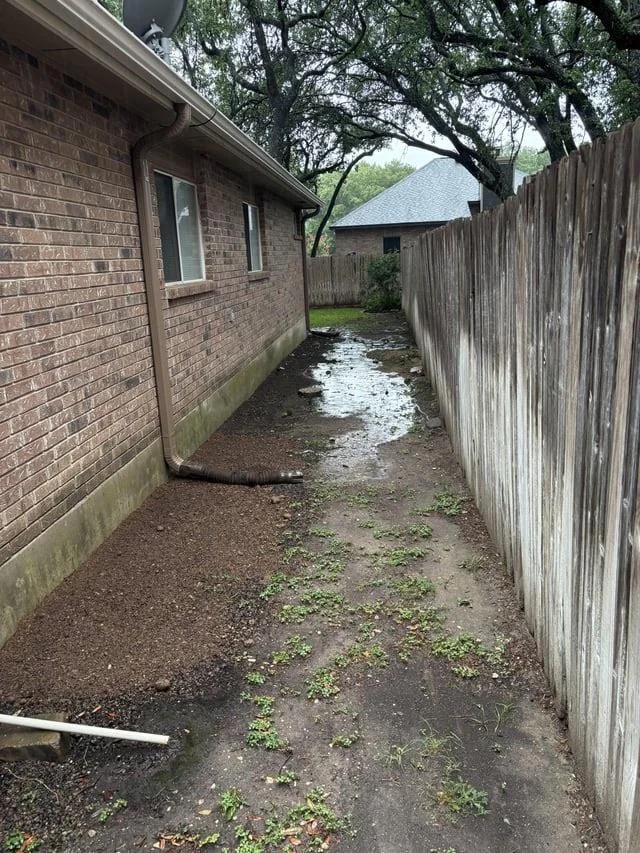
Before: standing water beside the house, San Antonio, TX. 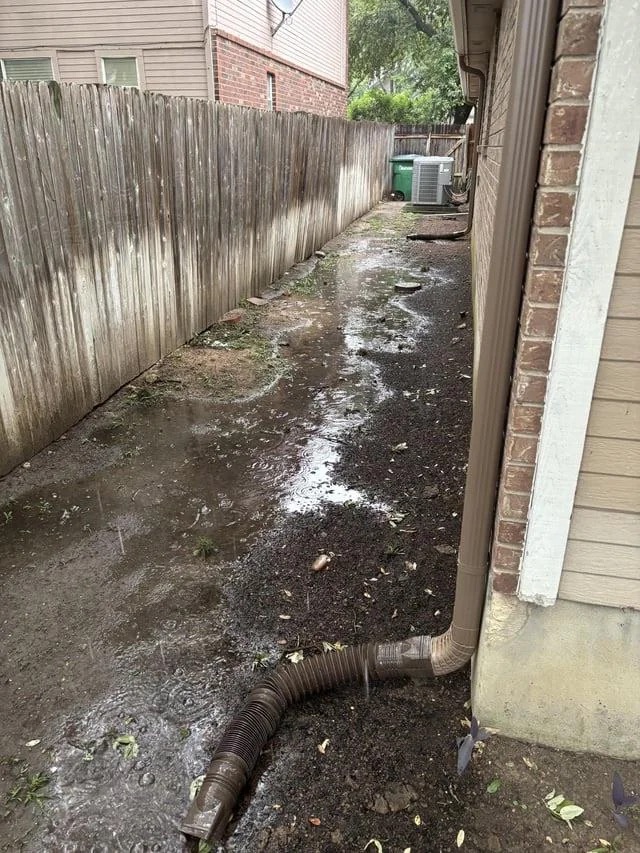
During: the drainage path after regrading, San Antonio, TX. 
After rain: water moving through the finished system, San Antonio, TX. 
Finished: river rock and native planting established, San Antonio, TX.
The approach
Move the water, keep the roots.
Standing water collected along one side of the house whenever it rained. The property was relatively flat and contained established trees, so trenching for a conventional French drain was not a good fit for the site goals. The priority was to move water away from the structure while preserving the surrounding root systems.
Excavated the existing side-yard soil.
Regraded the trough so runoff moved toward the backyard.
Used clay soil to shape the drainage profile and build grade away from the foundation.
Installed woven geotextile between the shaped soil and river rock to limit settling and material migration.
Used river rock as erosion control along the water path.
Planted roughly 30 to 40 native plants through the finished rain-garden area.
Site details
Shaped around the property instead of forcing a standard drainage solution.
The collection/berm area was placed about 10 feet from the foundation. The house was a one-story slab-on-grade structure, which gave some flexibility to build grade near the wall while keeping the drainage trough lower. The downspout area was shaped so water naturally moved away from the foundation and into the rain-garden path.
Existing mature trees remained part of the system. Their root zones were preserved rather than cut through for a deep drainage trench, and the surrounding vegetation helped with water uptake.
Outcome
A functioning drainage landscape instead of a muddy side yard.
Water moved away from the house
The regraded channel directed runoff toward the backyard collection area rather than allowing it to sit directly alongside the structure.
Native planting added function
The planting helped turn a drainage problem into habitat and landscape value, with native species selected for the local Zone 8b conditions.
Standing water drained faster
After the project, pooled water generally receded in roughly 2 to 3 hours rather than lingering, while the rock helped reduce erosion along the flow path.
What a similar project can include
Site-specific by design.
Rain-garden and ecological-drainage projects can involve site observation, basic grading, downspout diversion, shallow swales or troughs, erosion-control stone, native planting and soil-building. The right solution depends on slope, foundation conditions, utilities, trees, soil and where water can safely move.
Project pricing is site-specific. This case study does not publish the original price or labor hours because those records are no longer available.
Start Your Project
Dealing with standing water or a difficult garden site?
Standard appointments run 8 AM to 5 PM. Same-day work may be available when the schedule allows and carries the standard $100 rush fee. Work before 8 AM or after 5 PM is after-hours service at 1.5x the applicable hourly rate with a two-hour minimum.
Send photos of the area during or just after rain, the downspouts, the foundation edge and where the water naturally wants to move.